
Original blog post May 4, 2018. Revised and published again on April 29, 2026.
by Leslie Saidak
Maynard Ferguson was a charismatic and gifted trumpet virtuoso, with a career spanning over 50 years. He performed all over the world, touching countless lives with his music. Throughout his career as a musical superstar, he also made a point to mentor young band members and teach clinics for high school band students, leaving a legacy of vibrant young trumpet players eager to follow in his footsteps.
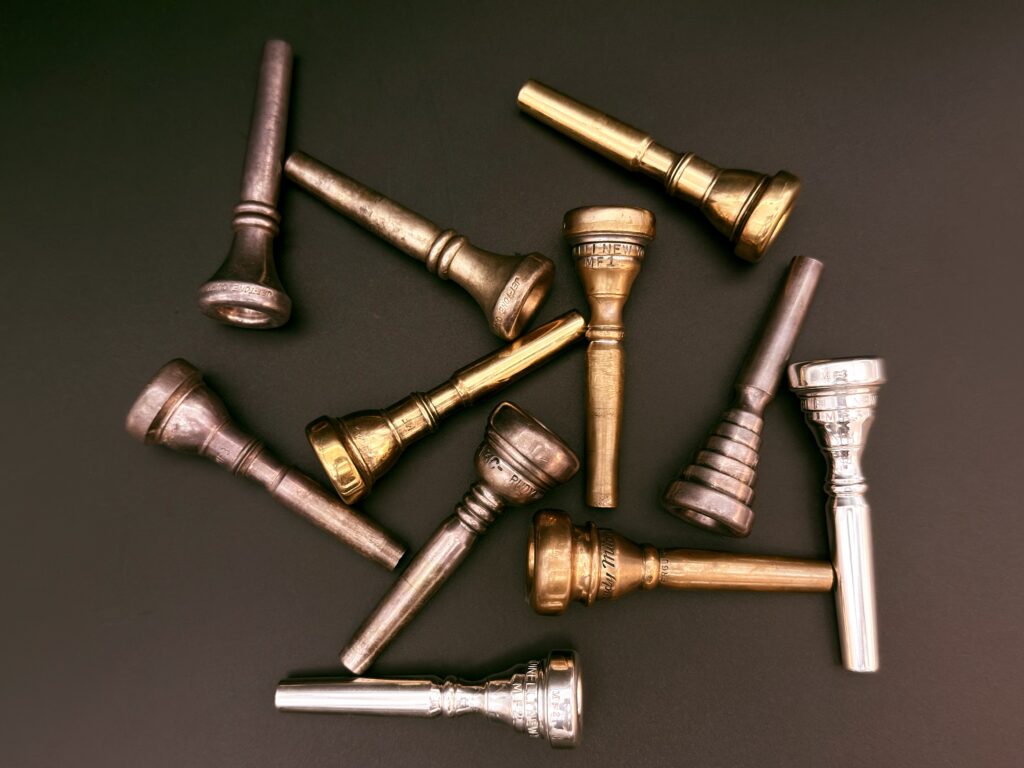
Throughout the years, he used many different trumpets and trumpet mouthpieces, created by various craftsmen at different companies. This post takes a detailed look at the main trumpet mouthpieces he used, and the specifics of how they evolved through the decades.
Trumpet mouthpieces used by Maynard Ferguson with approximate dates:
- Rudy Muck 13C (1939-1941)
- Dominick Calicchio piece, nicknamed “The Holy Grail” (1955-1963)
- Giardinelli MF1 and MF2 (1963-1969)
- Ferguson-Bell-Limited pieces (1969-1973)
- Holton MF1, MF3 and MF6 (early 1970’s)
- JET-TONE MF Personal, M.F. #2, and M.F. #3 (mid 1970’s-1980’s)
- Schilke MF1 and MF2 (1986-1990)
- Monette MF II and MF III (1992-2006)
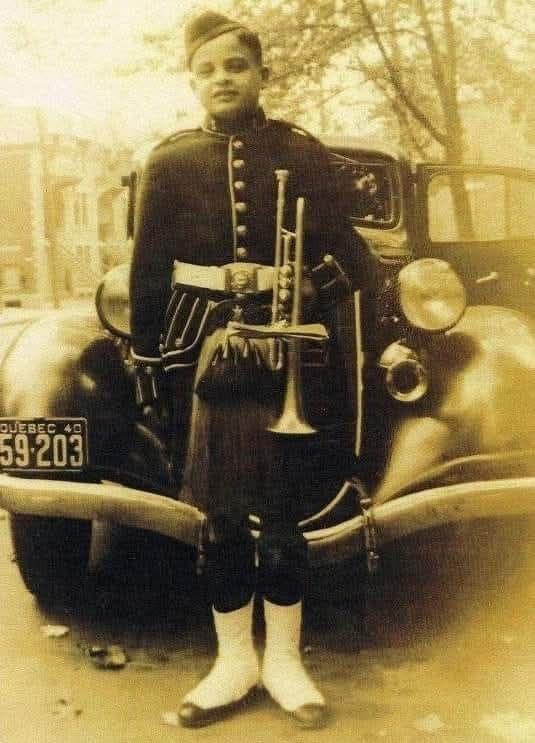
Walter Maynard Ferguson was born on May 4, 1928 in Verdun, Quebec, Canada. Although he started with violin and piano, he began playing trumpet at age 9. At age 13, he had a solo with the Canadian Broadcasting Corporation Orchestra, and at age 14 he earned a scholarship to the Conservatoire de musique du Quebec a Montreal. The child prodigy was on his way to becoming known as one of the most gifted trumpeters of all time.

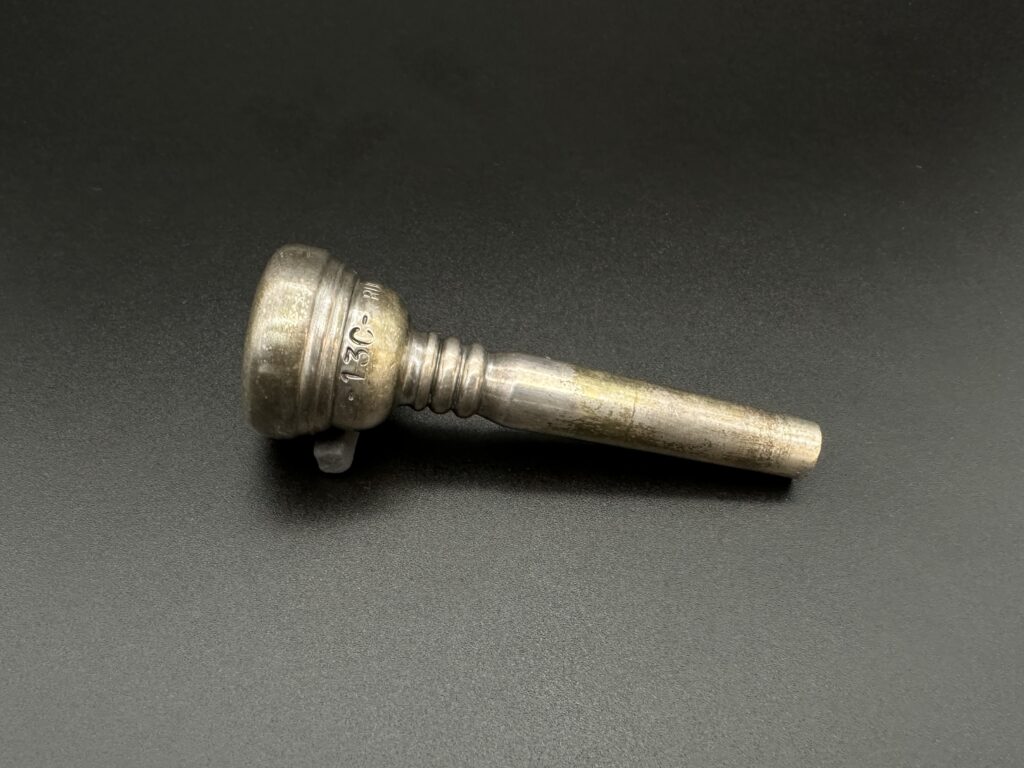
Rudy Muck 13C mouthpiece, created by Rudy Muck.
1939-1941 At the beginning of his career, while he was still living in Canada, Maynard used a Rudy Muck 13C. It is said he modified this mouthpiece by sanding down the rim to make better use of the V shaped cup. The inside rim diameter was originally .640″ before the rim was modified.
In the mid 1940’s, John DiStaulo was asked by Maynard’s parents to make a mouthpiece for their son. DiStaulo was a well known Canadian lead trumpet player who also made mouthpieces in his basement. He used the modified Rudy Muck 13C design to create a mouthpiece for Maynard with a wide, flat rim and V-bowl cup. The rim was rounded on the inside and outside edges, and the inside diameter was small, probably around .636″. Many people believe that this mouthpiece design was the key that unlocked Maynard’s range and control in the extreme upper register. From that point on, his playing developed into a talent that is unmatched, bringing musicality and electricity to the entire range of the trumpet.
Sometime later, Rudy Muck produced a mouthpiece like Maynard’s modified version of the 13C. It was labeled either “Rudy Muck Cushion Rim 13C, Special .636 M.F.”, or “Rudy Muck Cushion Rim 13C Maynard Ferguson”. Very few of these are still in existence.
Maynard moved to the U.S. in 1948 and played with bands led by Boyd Raeburn, Jimmy Dorsey and Charlie Barnet. In 1950 he joined Stan Kenton’s Orchestra. From 1953-1956 he was a sessions player for Paramount Pictures in Hollywood, CA. During this time, Maynard used a large bore Selmer, extra-large bore Bach (1952-53), a Martin Committee Model, and then a Calicchio trumpet.
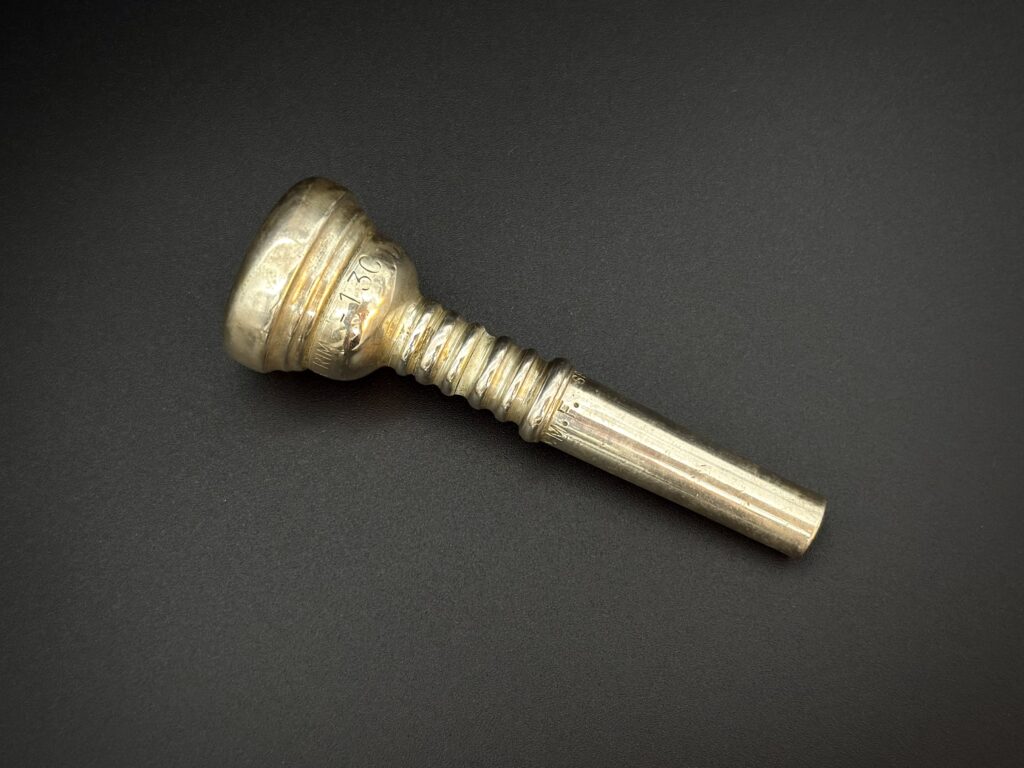

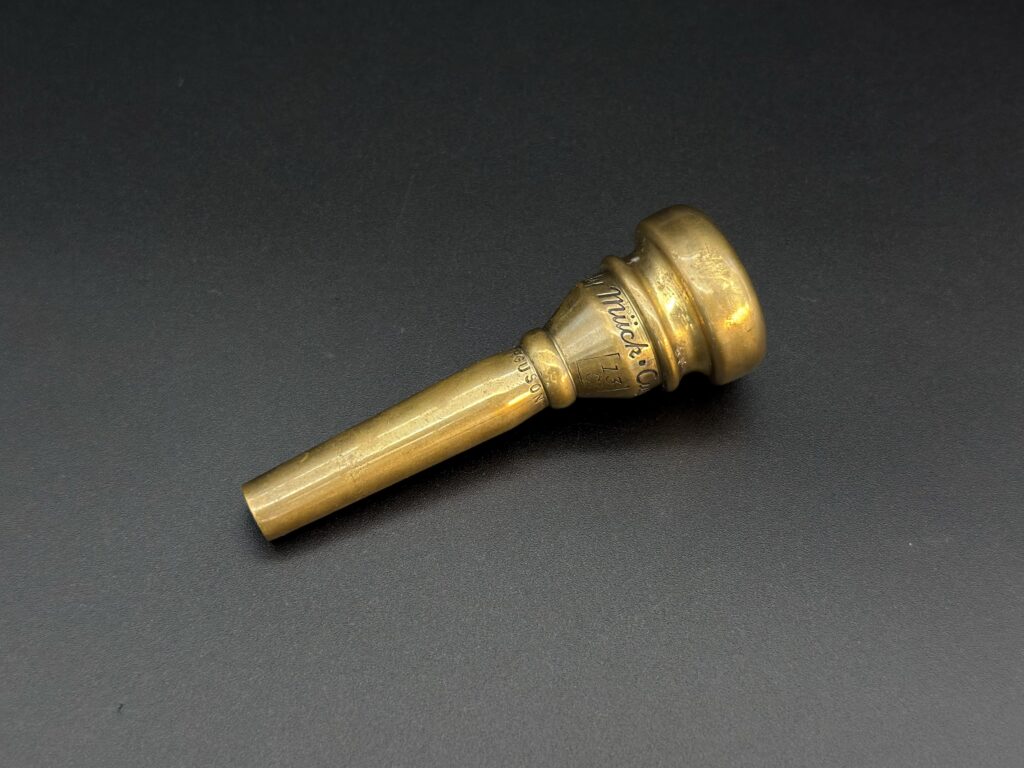
Custom mouthpiece created by Dominick Calicchio, “The Holy Grail”.
In 1955, Maynard had renowned trumpet craftsman Dominick Calicchio create a mouthpiece for him. It had a round inside rim with a diameter of around .623” (It’s hard to measure accurately due to the roundness). Built on the concept of the modified Rudy Muck 13C, it had a shallow concave V cup (also called a V bowl) and a #26 throat. Maynard Ferguson used this mouthpiece during his rise to fame, and eventually gifted it to a member of his band. It was well liked by many superstar trumpet players who tried it, and gained the nickname “The Holy Grail”. It has been reproduced by more than one company over the years, and sold under names such as “Groovin High” and others. In 1956 Maynard formed the Birdland Dream Band. He used a Conn Constellation 38B trumpet (.438 bore) during this time. Recordings during this period include: “Boy with Lots of Brass”, and “Birdland Dream Band” Vol. 1&2.

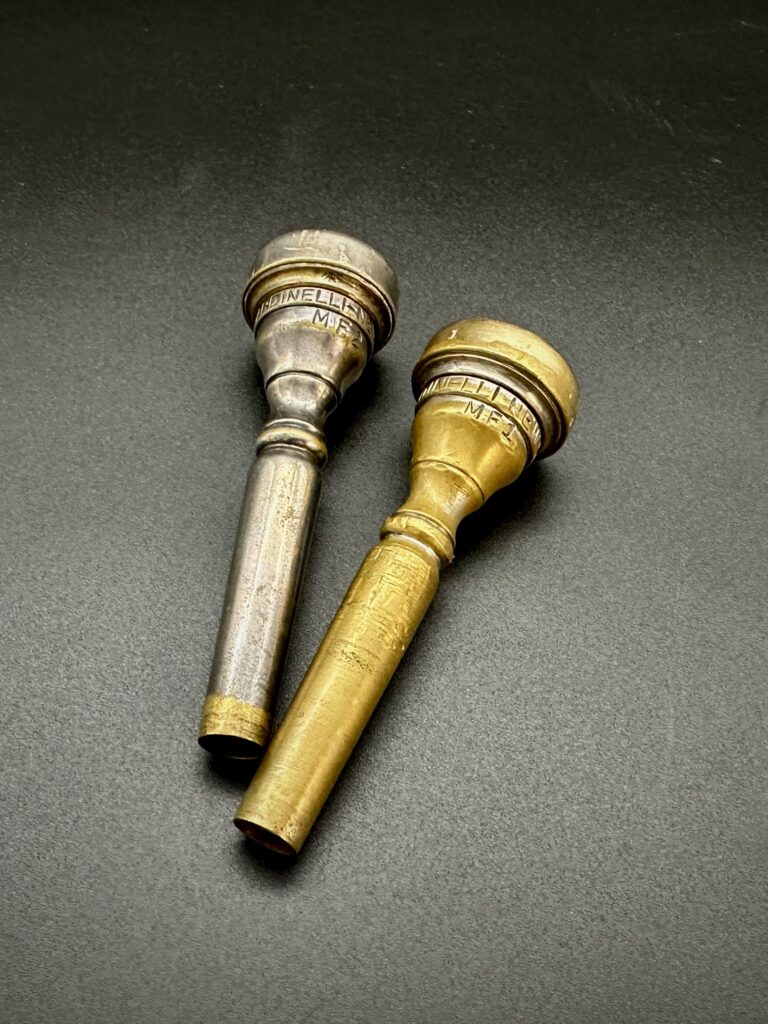
Giardinelli MF1 and MF2, created by Jack Onque.
1963-1969 Maynard was played Giardinelli mouthpieces made by machinist Jack Onque during these years. The MF1 had a rounded inside rim like his previous mouthpieces, with a smaller inside rim diameter of .590”. The cup was closer to a straight V shape (but still a V-bowl) and was slightly deeper than the Calicchio mouthpiece. The throat was still a #26. The MF2 had an even smaller inside rim diameter (.580”), and the cup was a slightly convex V shape. Maynard used the Giardinelli mouthpieces during his years in New York with the Birdland Dream Band, and during his years in India (1967-1969). He was still using his Conn Constellation 38B (.438 bore) trumpet. Recordings during this period included: “Maynard ‘63” and “The Maynard Ferguson Sextet”.


Ferguson-Bell-Limited, or FBL mouthpieces, created by Jack Bell.
1969-1973 In the late 1960’s, Maynard worked with Jack Bell, a mouthpiece maker in London, England to create a series of three mouthpieces. These mouthpieces all had the same rounded rim shape, with an inside diameter of .613”, a straight V cup, and a #26 throat. There were three cup depths: FBL TS (or FBL personal), which was shallow, FBL TM (medium depth), and FBL TD (deepest cup). Maynard likely used these interchangeably as needed to get the best sound with that day’s chops. At this time Maynard was using his Liberator trumpet (.462 bore). Recordings during this time included: “M.F. Horn”, “M.F. Horn 2”, and “M.F. Horn 3”, including the songs “MacArthur Park”, “Give It One”, and “Hey Jude”.


Holton MF1, MF3, and MF6, created by Larry Ramirez.
1973 These were the next iteration of Maynard’s mouthpieces, but were still similar in many ways to the Giardinelli and FBL’s. The inside rim was still very round (and difficult to measure accurately) but the inside diameter was a little smaller at about .590”. The cup was now a slightly convex V shape. The MF1 stayed with a #26 throat, but the MF6 had a much larger #19 throat. The MF1 and MF6 had a shallow cup similar in depth to the FBL TS (Personal), but the difference in throat size creates different nuances in cup shape. The MF3, on the other hand, had a slightly wider inside diameter and a cup depth similar to the FBL TM. Maynard was using the Holton ST301 (.468 bore) and ST 302 (.468 bore) trumpets during this time. Recordings during this time include “M.F. Horn 4 & 5: Live at Jimmy’s” and “Chameleon”.


JET-TONE MF Personal, M.F. #2, and M.F. #3, created by Bill Ratzenberger.
In the mid 1970’s, Maynard worked with Bill Ratzenberger at JET-TONE to create three mouthpieces. The MF Personal had an inside diameter of .593”, a shallow, fully convex V cup, and #19 throat. The M.F. #2 had an inside diameter of .625”, a slightly deeper convex V cup, and #24 throat. The M.F. #3 had a .656” inside diameter, a convex V cup about the same depth as the #2, and a #26 throat. Maynard was playing a .468 bore Holton trumpet during this time. Albums during this time included “Primal Scream” with the song “Pagliacci”, “Conquistador” with the song “Gonna Fly Now (Theme from Rocky)”, “Carnival” including “Birdland”, “Stella by Starlight”, and “Theme from Battlestar Galactica”, and the album “New Vintage” including “Star Wars” and “Airegin”.
Schilke MF1 and MF2, made by Scott Laskey.
1986-1990 These models were similar to his JET-TONE mouthpieces, with some modifications. The MF1 had more of a bowl shaped or double cup, and the MF2 was very similar to the JET-TONE MF personal model. The throat was very open and may have been either a #24 or #19. Maynard was still using a Holton ST 302 (.468 bore) or ST 306 (.468 bore) trumpet at this time. In 1986, the High Voltage Septet was formed. Recordings included: “High Voltage Vol. 1” and “High Voltage Vol. 2”. In 1988, Maynard formed the Big Bop Nouveau band and recorded the album “Big Bop Nouveau”.
Monette MFII and MFIII, made by Dave Monette.
1992-2006 The mouthpieces made for Maynard by Dave Monette were a big change from previous designs. The MFII has an inside diameter of .636”, a medium shallow to shallow bowl shaped cup, and #16 throat. The MFIII has a slightly wider inside rim diameter, slightly more bite to the rim, and Monette’s “SLAP” cup. Maynard used these mouthpieces with the .464 bore trumpet also made by Dave Monette. Recordings during this time include “One More Trip to Birdland”, “Brass Attitude”, and “M.F. Horn VI: Live at Ronnie’s”.

Throughout the evolution of most of his mouthpieces, Maynard kept similarities to that first design from his earliest days on trumpet. He favored a flat rim with a rounded contour on the inside and outside edges. The inside diameter was often hard to quantify because of the roundness, but was usually small, between .590”-.636”. The cup shape was a concave V (or V bowl) early on, moved to a straight V with the Giardinelli and FBL mouthpieces, was a slightly convex V with the Holtons, and eventually a more pronounced convex V shape with the JET-TONE mouthpieces. He favored a larger-than-stock throat size, ranging from #26 – #19 or even larger. When he moved to Monette mouthpieces, he went in a new direction with a new cup shape and larger inside rim diameter.
Over the course of his career, Maynard Ferguson never stopped adapting, changing, and trying new ideas. His talent transcended his equipment, and his music is still just as powerful and exciting and compelling today as it was during his lifetime.
Availability of Maynard Ferguson’s mouthpieces today: The enduring popularity of Maynard Ferguson’s music has kept demand for his mouthpieces alive until the present day. Most of the original craftsmen are gone, and some of the companies have changed hands or gone out of business. As a result, many of the models described here have fallen out of production. However, Legends Brass is a reliable source for an extensive collection of replicas of Maynard Ferguson’s mouthpieces, including many models no longer available anywhere else. (See the catalog here.)
Sources:
- https://maynardferguson.com/biography/ . Retrieved from maynardferguson.com on 4/20/2020.
- https://en.wikipedia.org/wiki/Maynard_Ferguson . Retrieved 4/30/2020.
- https://www.trumpetherald.com/forum/viewtopic.php?p=1142786 . Retrieved from trumpetherald.com 5/4/2020.
This post was revised for publication May 4, 2026. The original blog post was May 4, 2018.
*Author’s Note: It’s often really hard to pin down exact specs on a particular vintage mouthpiece. Handmade mouthpieces have considerable variation. Sometimes (usually) Maynard had personal pieces with specs different from the stock pieces sold under his name. The curved nature of the rim makes it difficult to measure accurately. The above information was gathered from internet sources and online forums and may not be scientifically exact. I’ve been as accurate as possible. I welcome any additional information and input about Maynard’s mouthpieces. Feel free to contact me through the contact form at LEGENDSBRASS.COM.