

4/14/26
by James Eldreth, Guest Blogger
Legends Brass Dealer James Eldreth tried both the Legends Screamer and Funkin’ Screamin’ trumpet mouthpiece models. His experience was like so many trumpet players comparing two similar mouthpieces: one works great for him and the other one doesn’t work at all. He’s written this helpful article explaining why this can happen.
___________________________________________________________________
Mouthpieces are extremely personal and individual preferences vary widely based on things like style of music, desired tone, air usage, lip size, and facial structure. I recently tested all three mouthpieces in the Legends Funkin’ line with the intention of writing a review. Unfortunately, none of the mouthpieces worked for me, so I had my friend Max play each of them and write a review from his perspective. (Read Max’s review here.) He ended up purchasing the Funkin’ Screamin’ from me and it is now his go-to mouthpiece for lead work. My negative experience with something that was positive for another player ultimately led to this post as an attempt to explain why by analyzing multiple aspects of mouthpiece design.
My primary mouthpiece for lead work is the Legends Screamer. Since the Funkin’ Screamin’ is the most similar to the Screamer, let’s compare the two side by side.
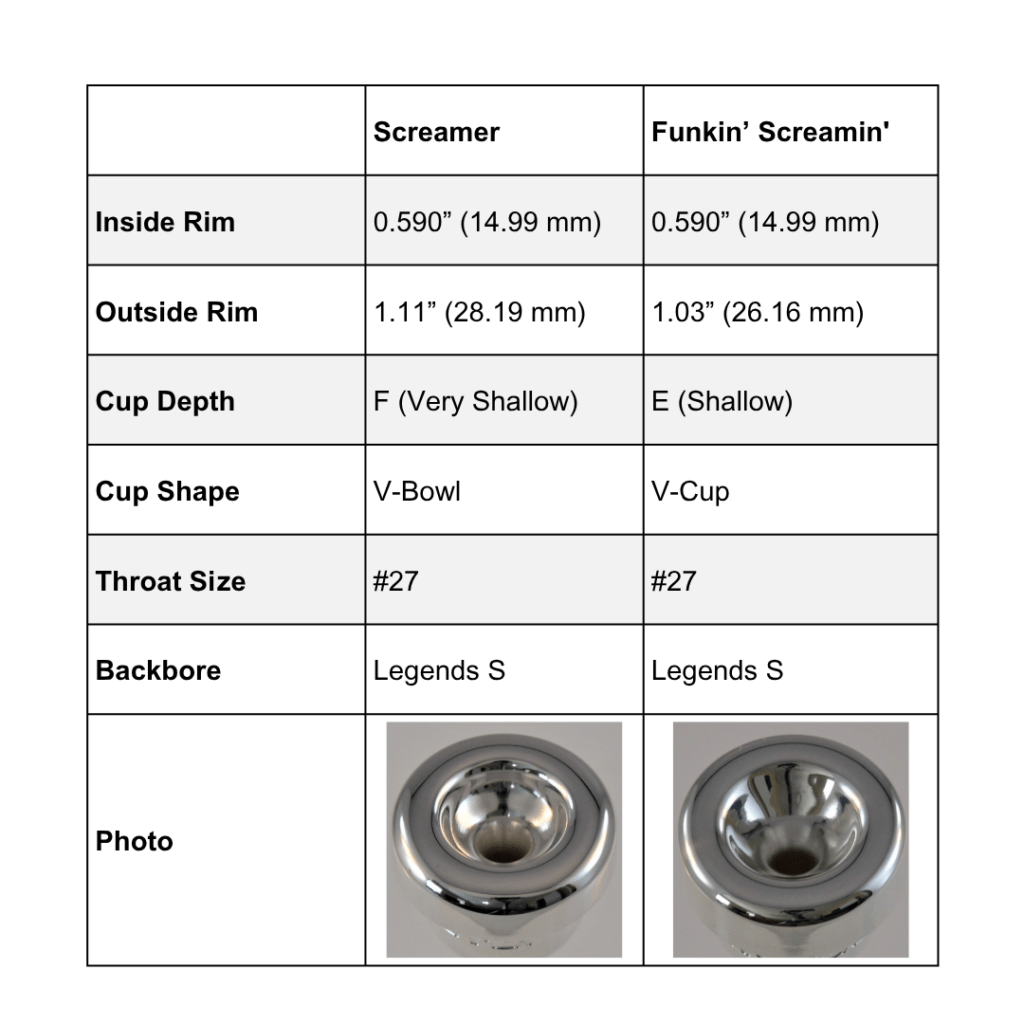
What’s the first thing that jumps out to you? If you’re like most people, it will be the cup depth. Since the Screamer has an F cup and the Funkin’ Screamin’ has an E cup, the Screamer is obviously smaller, right? Well, the answer is actually “sort of.” Let’s explore more.
Cup Depth
The cup depth is typically measured from the top of the rim to the point where the throat begins in the center of the cup. Based on this measurement alone, an F cup is shallower than an E cup. However, depending on cup shape, there may actually be more room in a shallower mouthpiece.
Cup Shape
For an in-depth discussion of cup shapes, please visit this Legends Brass post from 2019. Toward the end of the post are lists of Legends models separated by cup shape. The Funkin’ Groovin’ is listed as a Straight V shape, and it certainly feels to me like the rest of the Funkin’ line has the same shape. In contrast, the Screamer is listed as a Concave V (or V-Bowl) shape. As stated in the article, a Concave V (V-Bowl) cup has more cup volume than a Straight V cup. This is definitely true for cups of different shapes that have the same depth, but can also be true for cups of different shapes that have different depths, especially if the depth is only one letter different (such as the difference between E and F). More cup volume means more chop room, so a cup with an F depth that has a V-Bowl shape can feel bigger than a cup with an E depth that has a Straight V shape.
For me, the shallower F cup of the Screamer is perfect, but the deeper E cup of the Funkin’ Screamin’ feels like my lips bottom out and stop vibrating entirely. This is due to the cup shape. However, “hybrid” cup shapes like the V-Bowl are not all the exact same, so this may not be true for all mouthpieces with the same cup shape. But what specifically makes things feel so different? I’m glad you asked!
Inside Rim, Alpha Angle, & Beta Angle
Inside rim diameter is typically measured at the point where the flat part of the rim meets the very top of the cup. It’s important to note that there is not an industry standard for where this point actually is, and therefore a rim diameter of .590″ at one company might not be .590″ at another. See Legends Brass’s system of measurement here. When two rims feel different, the first order of business is to make sure the inside diameter was measured at the same point and they are truly the same size. Two rims that are identical in diameter can feel very different due to their shapes. Just beyond the inside rim measurement is the cup’s alpha angle.
Alpha angle is the measurement that tells you the slope of the transition from rim to cup. When you hear a player talking about a mouthpiece having more or less “chop room,” they are talking about the alpha angle. Likewise, when a player talks about a mouthpiece having more or less “undercut,” that also refers to the alpha angle. A lower alpha angle has more chop room and a higher alpha angle is what you are feeling if your lips “bottom out” on any given mouthpiece. Comparing our two mouthpieces above, the Screamer with a V-Bowl cup shape has a lower alpha angle and the Funkin’ Screamin’ with a Straight V cup shape has a higher alpha angle. The alpha angle is the main reason why the Screamer feels bigger and more open to me, even though it has a shallower cup depth. GR Mouthpieces has a great page, complete with a graphic, that explains alpha angles very well. While the alpha angle is talked about more, there is also a beta angle.
Beta angle is the measurement that tells you the slope of the transition from cup to throat. If you hear a player talking about a mouthpiece with a more rounded throat entrance, they are talking about the beta angle. A mouthpiece with a more rounded throat entrance has a lower beta angle. A lower beta angle has more cup volume, which can add a bit of warmth to the sound and may decrease back pressure. A higher beta angle may cause notes to speak more quickly, but will likely have a brighter tone and may have increased back pressure. GR Mouthpieces also has a page on beta angles, complete with another graphic.
Other Factors
Outside rim size may not seem important, but it tells you how wide the actual rim of the mouthpiece is. This can matter a ton, especially if you compare two mouthpieces—like the Legends BB and the Legends Supercat III—that have the same inside rim measurement, but a 0.18” difference in outside rim measurement. That is almost 1/5 of an inch difference and, on an area like your lips, feels huge.
Throats and backbores work hand-in-hand, at least in my mind. For me, like for many, the standard #27 throat with a standard backbore works the best, but that is certainly not the case for everyone. Players who use their air extremely efficiently typically like a smaller throat, ranging from #28 to around #30. However, I know players who like a bigger throat from #26 to around #24. I also know a couple players who use #20 and #18 throats on their trumpet mouthpieces to get more of a flugelhorn sound without changing anything else about their mouthpieces. As far as backbores, players who use smaller throats tend to also prefer tighter backbores, and vice versa. But, again, that is not always true for every individual and their preferences. There are players who prefer a smaller throat due to the increased resistance but like a more open backbore to help shape their tone. There are also players who prefer a larger throat and a tighter backbore because they want the resistance they feel to come after the air exits the cup. It is all truly personal preference in both feel and desired outcome.
Conclusion
All of the factors outlined above come together to influence how a mouthpiece works for each player. When trying a new mouthpiece it is often helpful to make only small changes to one element of the mouthpiece at a time. Making drastic jumps in rim size, cup depth, and more will almost certainly change your sound- for better or for worse, but you probably won’t know why. It’s better to choose a mouthpiece similar to your current piece but with a slightly smaller inside rim diameter, for example, or a slightly shallower cup. This will allow you to evaluate whether you’re on the right track to your goal, whether that be increased range, better tone, more endurance, etc. It’s usually possible to consult with the mouthpiece dealer, and sometimes even try demos, before you buy.
I would welcome comments or stories of your own personal experiences with mouthpieces, especially those “a-ha” moments that may have changed the way you think about or approach mouthpieces.
Thanks for your time.
James Eldreth, Ph.D.
Legends Brass Mouthpiece Dealer
Crooner & Co. Swing Band
Music Teacher, Central Mountain High School
Adjunct Director of Bands, Commonwealth University of PA—Lock Haven